Overview
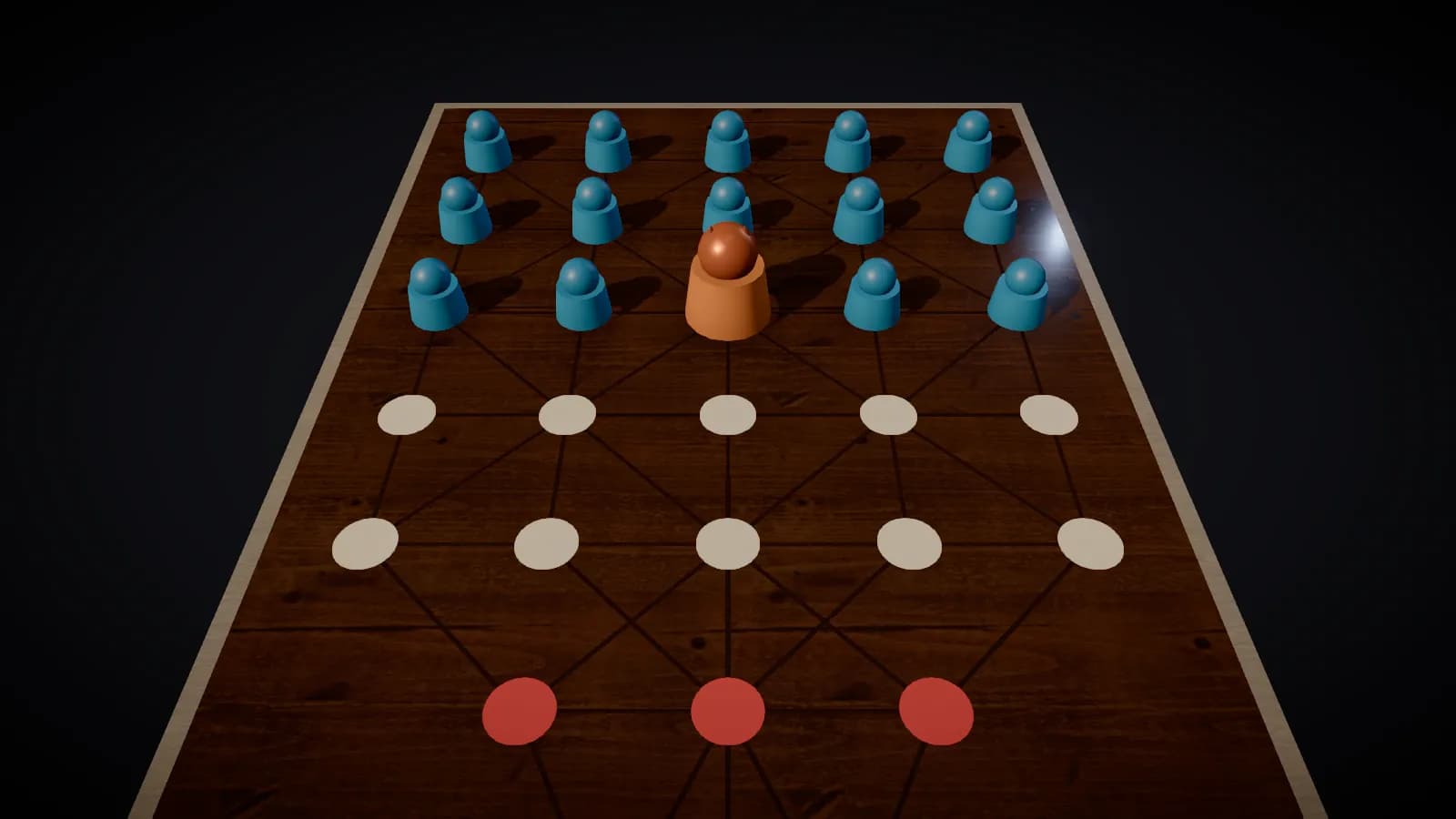
Jogo da Onça (The Jaguar Game) is an ancient indigenous asymmetric hunt board game played by the Bororo and Guaraní peoples of Brazil. One player commands the solitary Jaguar (Onça), while the other commands a pack of 14 Dogs (Cachorros), attempting to trap the predator on a 5x5 grid with an attached triangular den (toca).
Origin & Region
Mato Grosso and Amazon Basin (Bororo, Guaraní, and Xingu indigenous nations).
Players & Materials
Grid board (5x5 square plus 3x3 triangular triangle/toca, 31 intersection points), 1 jaguar stone, 14 dog stones.
Objective
Execute traditional scoring, capture, or victory conditions.
Rules
he Jaguar starts in the center of the 5x5 board; the 14 Dogs occupy the top rows.
Pieces move one step along marked orthogonal or diagonal lines to adjacent empty intersections.
The Jaguar captures a Dog by jumping over it in a straight line into an immediately vacant intersection behind it (multiple jumps allowed).
Dogs cannot jump; they must cooperate to surround and immobilize the Jaguar with no legal moves.
The Jaguar wins by capturing 5 Dogs (preventing a trap); the Dogs win by completely trapping the Jaguar.
Variants
Traditional regional variants exist in playing area, equipment tuning, and rules.
Cultural Notes
An integral part of local oral tradition, seasonal celebrations, and national cultural heritage.
Sources
- Museu do Índio / FUNAI, Jogos e Brincadeiras Indígenas do Brasil, Rio de Janeiro.
- Almeida, M., Jogos Tradicionais e Culturas Indígenas, SESC São Paulo.