Overview
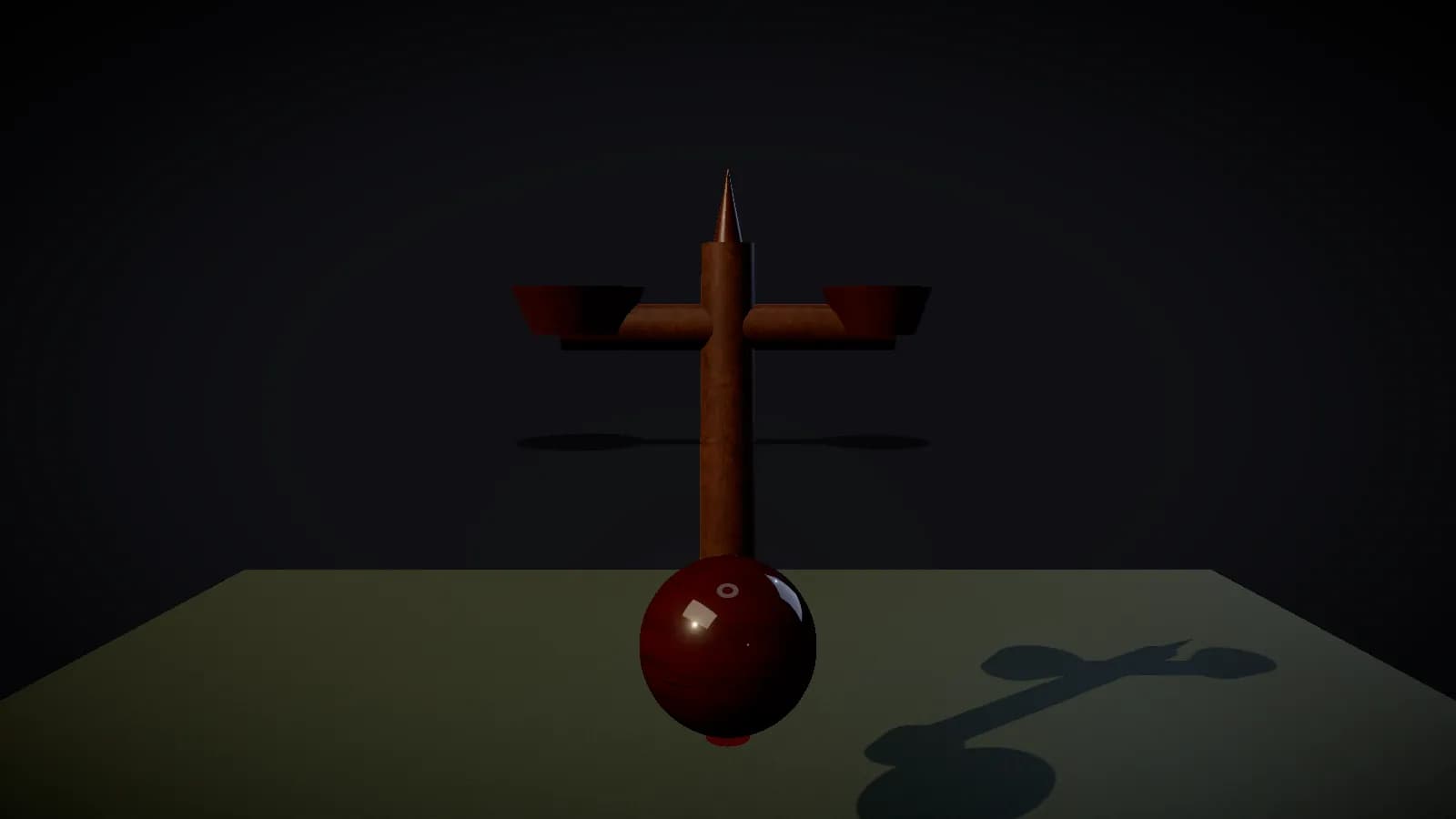
Kendama is a traditional Japanese wooden cup-and-ball dexterity skill toy consisting of a handle (ken) shaped like a cross with three cups of varying sizes and a pointed spike, connected by a string to a wooden ball (tama) with a drilled hole. Players use rhythmic knee flexion, wrist control, and spatial timing to swing, catch, balance, and flip the ball onto the cups or impale it onto the spike in hundreds of standardized, progressively demanding trick combinations.
Origin & Region
Evolved from European bilboquet and cup-and-ball games introduced via Nagasaki during the Edo period (initially documented as a drinking game called Sukuitamaken / 掬い玉剣 in 1777). In 1919 (Taishō 8), Hamaji Egusa of Kure, Hiroshima patented the modern design featuring side cups, called the Nichigetsu-boru (Sun and Moon Ball). Mass production centered in Hatsukaichi, Hiroshima. In 1975, children's author Issei Fujiwara founded the Japan Kendama Association (日本けん玉協会), standardizing dimensions, trick taxonomies, and ranking systems.
Players & Materials
- Players: 1 player (solo progression) or 2+ players in head-to-head match battles
- Equipment: 1 certified Kendama (Kyōgi-yō Kendama):
- Handle (Ken / 剣): ~16 cm height, comprising a top spike (Kensaki), a cross-piece (Saradō) containing the Big Cup (Ōzara, ~4.2 cm diam.) and Small Cup (Kozara, ~3.8 cm diam.), and a Base/Middle Cup (Chūzara, ~3.5 cm diam.) at the handle bottom.
- Ball (Tama / 玉): ~6 cm diameter wooden sphere with a single tapered hole (ana), connected by a ~40 cm nylon string.
- Playing space: Flat open indoor or outdoor floor area with at least 2 meters of clear vertical overhead space
Objective
Successfully execute designated catching and balancing tricks within allowed attempt quotas or perform continuous rhythmic trick sequences without dropping the ball.
Rules
rips (Mochikata): 1.1. Ozara-mochi (Big cup grip): Holding the body of the ken between thumb and forefinger below the cross-piece. 1.2. Rōsoku-mochi (Candle grip): Gripping the pointed spike tip between thumb and forefingers. 1.3. Tama-mochi (Ball grip): Holding the wooden ball with the hole pointing upward.
Standard Basic Tricks (JKA 10-Trick Kyū Ladder): 2.1. Ōzara (Big Cup): Pull ball vertically upward and catch in the Big Cup. 2.2. Kozara (Small Cup): Pull ball vertically upward and catch in the Small Cup. 2.3. Chūzara (Middle Cup): Pull ball vertically upward and catch in the Base Cup. 2.4. Rōsoku (Candle): Hold spike tip in candle grip; pull ball up and catch in the Base Cup. 2.5. Tomeken (Spike Catch): Pull ball straight up without swinging or spinning, catching the ball hole directly onto the spike. 2.6. Hikōki (Airplane): Hold the ball; swing the handle in an arc forward and catch the incoming spike into the ball hole. 2.7. Furiken (Swing Spike): Hold the handle; swing the ball outward in an arc and catch the rotating ball onto the spike. 2.8. Nihon Isshū (Around Japan): Kozara → Ōzara → Spike catch in one unbroken sequence. 2.9. Sekai Isshū (Around the World): Kozara → Ōzara → Chūzara → Spike catch in unbroken sequence. 2.10. Tōdai (Lighthouse): Hold the ball; pull the handle vertically upward and balance its Base Cup upright on top of the ball for at least 3 seconds, followed by falling onto the spike or into the hand.
Rhythmic Endurance Trick (Moshikame / もしかめ): 3.1. Continuous alternating bouncing of the ball back and forth between the Big Cup and the Middle Base Cup to the rhythm of the nursery song "Usagi to Kame" (Moshi moshi kame yo, kame-san yo). 3.2. Official standard: Minimum tempo of 135 catches per minute without stopping.
Match and Certification Rules: 4.1. In official ranking tests, a player is allowed up to 10 trials per trick, needing a prescribed number of successes (e.g. 1 to 3 successes) to advance. 4.2. In 1v1 Battle Matches: Players alternate choosing tricks. If Player A succeeds, Player B must match it. If Player B fails, Player A scores 1 point. First to 3 points wins. 4.3. Touch faults: Touching the ball with the free hand during an attempted trick or letting the string tangle results in an immediate failed trial.
Variants
- Moshikame Marathon (もしかめ耐久競技): Endurance competitions where players perform unbroken Moshikame for hours (world records exceed 8 hours).
- Kendama World Cup (KWC): Modern international freestyle competition featuring complex aerial juggling, string grabs, and balance pivots.
- Sukuitamaken (掬い玉剣): Historical Edo-period precursor played with a cup-horn scoop and ball.
Cultural Notes
Kendama is designated by the Japanese Ministry of Education as a beneficial pedagogical activity in elementary schools for developing spatial awareness, balance, concentration, and perseverance. Hatsukaichi in Hiroshima Prefecture hosts the annual Kendama World Cup and is celebrated as the "Birthplace of Kendama."
Sources
- [Japanese] 日本けん玉協会認定規程および技の解説 — 公益社団法人 日本けん玉協会 (Japan Kendama Association). Language:
ja. https://kendama.or.jp. Accessed 2026-08-15. Type: national-federation. Notes: official dimensions, 10 Kyū trick specifications, Moshikame tempo rules, and trial quotas. - [Japanese] けん玉の発祥と歴史 — 廿日市市教育委員会 (Hatsukaichi City Board of Education). Language:
ja. https://www.city.hatsukaichi.hiroshima.jp. Accessed 2026-08-15. Type: municipal-heritage. Notes: Egusa Hamaji patent, Nichigetsu ball history, and woodcraft heritage. - [Japanese] 日本の伝承玩具・けん玉の変遷 — 日本玩具博物館 (Japan Toy Museum). Language:
ja. https://japan-toy-museum.org. Accessed 2026-08-15. Type: regional-museum. Notes: Edo Sukuitamaken origins and Meiji/Taisho physical toys.