Overview
Kubb is a traditional Swedish lawn throwing game originating from the island of Gotland in which two opposing teams take turns throwing wooden batons to topple wooden blocks (kubbar) on a rectangular grass or gravel pitch. Teams must knock down opponent field and baseline blocks before capturing the central king block (kung) to win the match.
Origin & Region
Kubb has roots in Gotland folk traditions, where the word kubb designates a block of chopped firewood (vedkubb). While informal block-throwing games have long existed in rural Gotland, modern standardized kubb took shape in the late 20th century. The first organized Kubb World Championship (VM i Kubb) was held in 1995 in Rone on southern Gotland, which codified the international competitive rules while retaining its traditional outdoor folk character. Today it is played nationwide across Sweden, especially at Midsummer, summer cottages (sommarstugor), and picnics.
Players & Materials
- Players: 2 teams (1 to 6 players per team; 2 vs 2 or 6 vs 6 are most common)
- Equipment: 1 wooden King block (kung, approx. 30 × 9 × 9 cm, often crowned), 10 wooden baseline/field blocks (kubbar, approx. 15 × 7 × 7 cm), 6 cylindrical wooden throwing batons (kastpinnar, approx. 30 cm long, 4–5 cm diameter), and 4–6 boundary corner stakes (hörnpinnar)
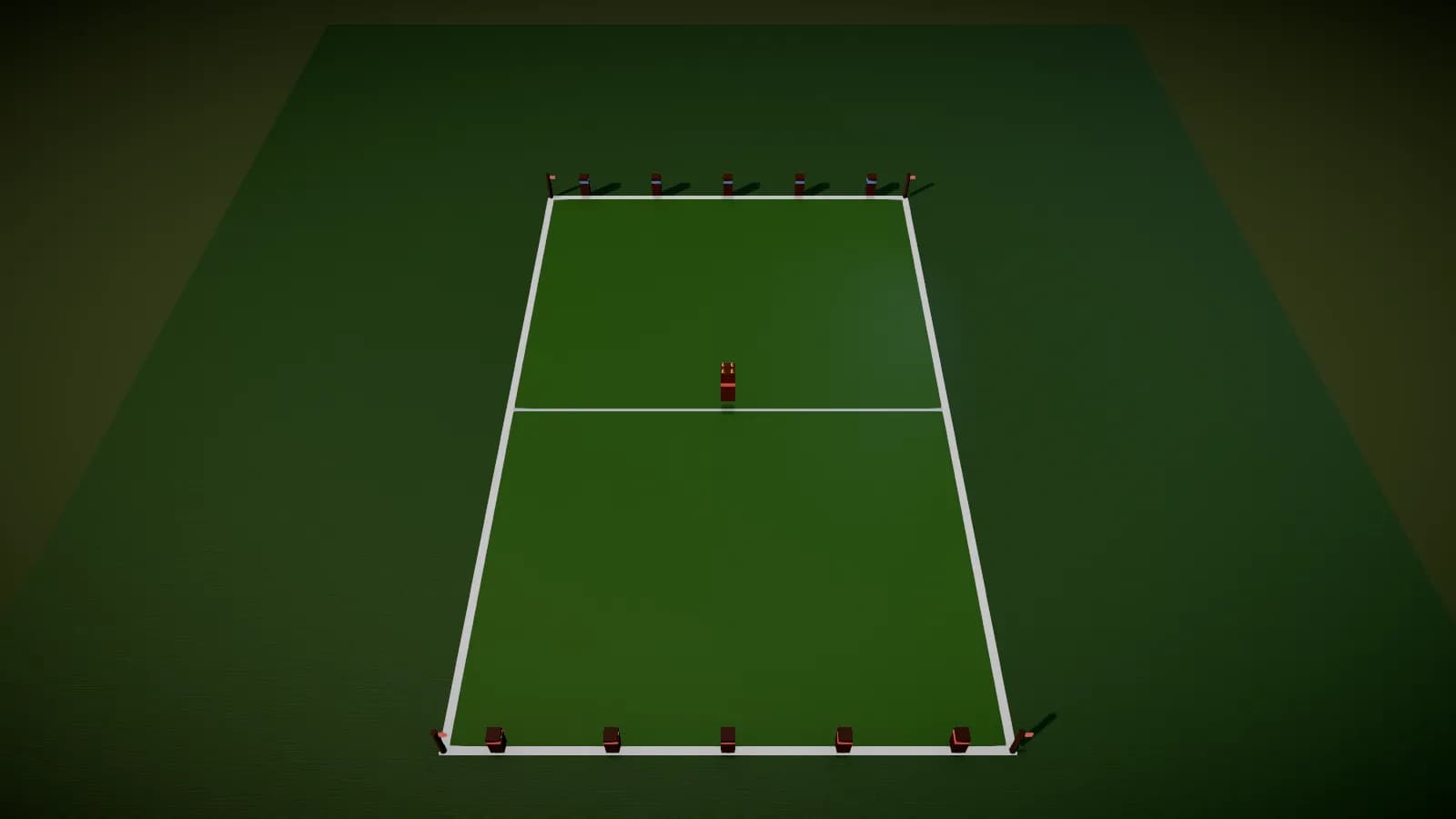
- Playing space: Rectangular level pitch, traditionally 5 × 8 meters on grass, turf, gravel, or sand, with marked corner stakes, two 5-meter baselines, and a center line dividing the pitch into two 5 × 4 meter halves
Objective
Topple all opposing field and baseline kubbs, and finally topple the central king block by throwing batons from the legal throwing line, without toppling the king prematurely.
Rules
etup: The king is placed upright on the center line. Five kubbar are placed standing upright and evenly spaced along each team's 5-meter baseline.
Team A opens by throwing the 6 throwing batons underhand, end-over-end along the vertical axis (helicopter/horizontal spinning throws are illegal), from behind their baseline toward Team B's baseline kubbar.
If any baseline kubbar are toppled, Team B collects them. At the start of Team B's turn, Team B throws these toppled kubbar from behind their own baseline into Team A's half of the pitch.
Team A stands each thrown kubb upright at the exact spot where it landed in their half; these become "field kubbar" (fältkubbar). If a thrown kubb lands outside Team A's half after two attempts, Team A may place it anywhere in their half at least one baton-length from the king or boundary.
Team B must now throw their 6 batons from their baseline. Team B is obligated to topple all field kubbar in Team A's half before they are permitted to attack Team A's baseline kubbar.
If Team B fails to knock down all field kubbar in Team A's half during their turn, the standing field kubb closest to the center line becomes Team A's temporary advanced throwing line (fältlinje) for their subsequent turn.
Play alternates between teams following this cycle: throwing fallen kubbar into the opponent's half, raising them as field kubbar, eliminating field kubbar first, and then attacking baseline kubbar.
Once a team has successfully toppled all opponent field kubbar and all five baseline kubbar, they may throw at the central king block from their baseline.
Toppling the king after clearing all opponent kubbar wins the game immediately.
If a team knocks down the king at any point before all opposing kubbar are cleared, that team loses the game immediately.
exact overtime procedures in traditional non-tournament play when match exceeds standard time
Variants
- Gotland casual play: Flexible pitch sizes (e.g. 4 × 6 m for children or confined gardens) and varied kubb dimensions.
- World Championship (VM) rules: Strict 5 × 8 m pitch, official baton rotation checks, and best-of-three game series.
- Tower variant (Kubb-torn): When toppled kubbar are thrown back into the opponent's half, if one hits another already thrown, they may be stacked into a tower.
Cultural Notes
Kubb is considered Sweden's quintessential summer lawn game. It features prominently in Midsummer celebrations, family reunions, and Swedish camping and leisure culture. While heavily associated with Gotland cultural pride and the annual Rone championship, it is embraced throughout Scandinavia as a social, low-barrier outdoor tradition.
Sources
- [Swedish] Kubb (spel) — Svenska Wikipedia. Language:
sv. https://sv.wikipedia.org/wiki/Kubb_(spel) Accessed 2026-08-14. Type: encyclopedia-entry. Notes: Gotland heritage, equipment specifications, historical background. - [Swedish] Officiella spelregler för Kubb — Svenska Kubbförbundet / VM i Kubb (Rone, Gotland). Language:
sv. https://www.kubb.world/rules Accessed 2026-08-14. Type: national-federation. Notes: Complete competitive rules, throwing mechanics, field kubb procedures, and king win/loss conditions. - [English] Traditional Gotland and Swedish Folk Sports — European Traditional Sports and Games Association (ETSGA). Language:
en. Accessed 2026-08-14. Type: supplement. Notes: Context on Gotland traditional games and social transmission.