Overview
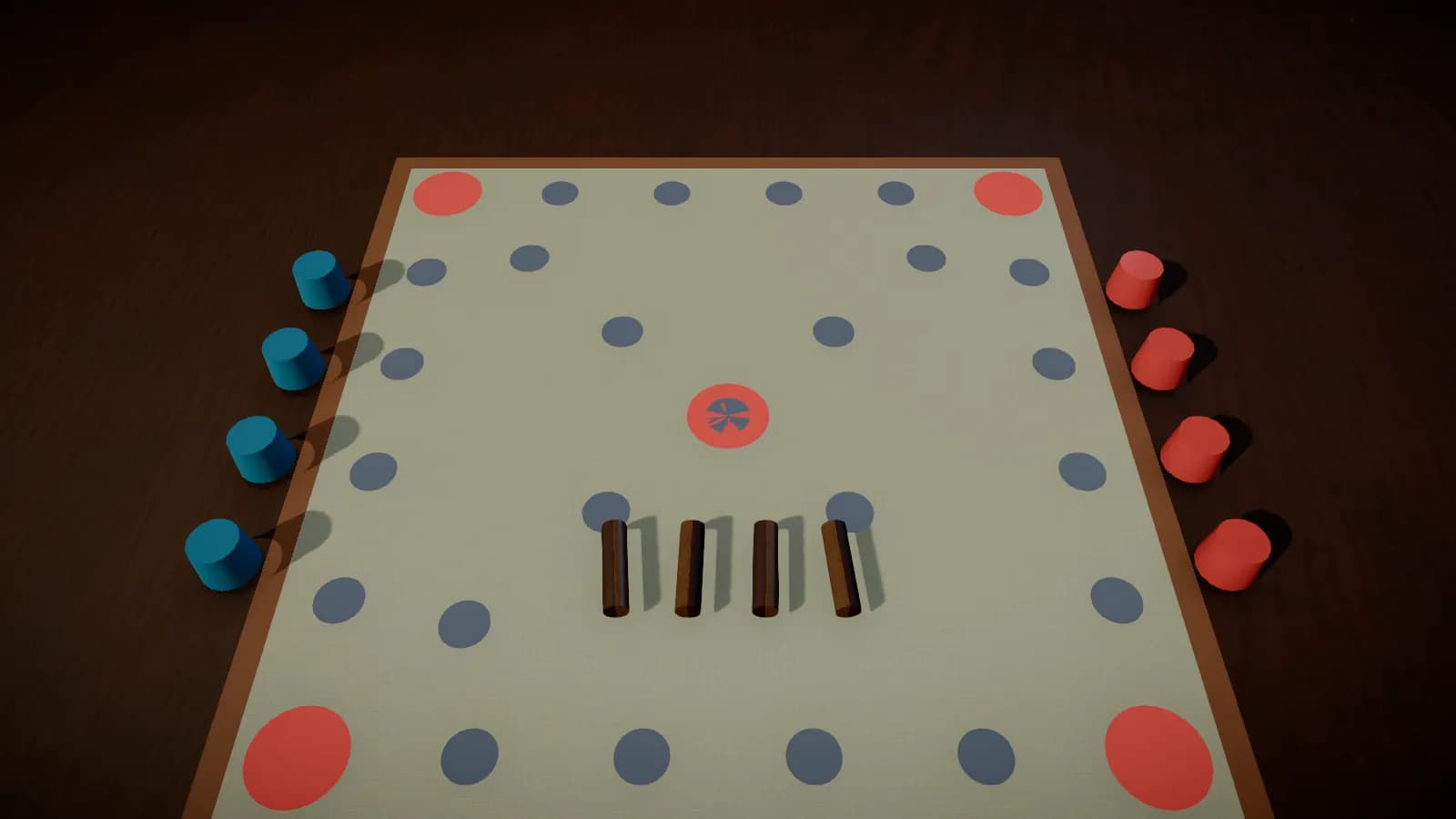
Yutnori is Korea's classic turn-based race board game played with four cast wooden staves (yutgarak) and four tokens (mal) per side. Played traditionally from New Year's Day (Seollal) to the First Full Moon (Jeongwol Daeboreum), players or teams cast the staves onto a mat to determine movement distances around a 29-station circuit. Combining tactical path selection, piece capturing, and token stacking with the probability distribution of asymmetric two-sided staves, it is one of Korea's most enduring communal folk pastimes.
Origin & Region
Attested historically in Chinese and Korean chronicles of the Three Kingdoms period (Goguryeo, Baekje, Silla) and formalized in Joseon-era compendia including Seongho Saseol (성호사설) by Yi Ik and Dongguk Sesigi (동국세시기, 1849). The five primary casting results correspond to livestock animals in ancient tribal governance (pig, dog, sheep/goat, ox, horse). Designated South Korea's National Intangible Cultural Heritage No. 145 in 2022.
Players & Materials
- Players: 2 individual players or 2 opposing teams (any number of participants per team); each side controls 4 tokens (mal)
- Equipment: 4 wooden casting sticks (yutgarak, approx. 15–20 cm long, flat on one face, semi-circular convex on the other; one stick marked on the flat face for Baek-do), 1 game board sheet (yutpan, circular or square with 20 perimeter stations and an inner 9-station cross with central hub bang), 8 marker tokens (coins, buttons, or carved wood pieces)
- Playing space: Flat indoor or outdoor surface covered with a straw mat (meongseok) or cloth blanket
Objective
Be the first player or team to navigate all four tokens completely around the track and off the board at the exit point.
Rules
eams decide starting turn order by casting sticks or playing rock-paper-scissors (Gawi-bawi-bo).
On their turn, an active player casts all four wooden sticks onto the mat.
The movement value is determined by the combination of flat (upward) and convex (downward) faces:
- Do (도): 1 flat face up, 3 convex faces up advance 1 station.
- Gae (개): 2 flat faces up, 2 convex faces up advance 2 stations.
- Geol (걸): 3 flat faces up, 1 convex face up advance 3 stations.
- Yut (윷): 4 flat faces up advance 4 stations, plus earn an immediate bonus throw (sari).
- Mo (모): 4 convex faces up (all flat down) advance 5 stations, plus earn an immediate bonus throw (sari).
- Baek-do / Dwi-do (백도 / 뒷도): The single marked flat face up alone move 1 station backward. If no token is currently on the board, regional traditions vary between remaining in place or moving backward to the end station.
Bonus throws accumulate: a player who casts Yut or Mo casts again before moving, and may execute their moves in any desired combination across their active tokens.
Entering the board: A token enters at the start station (chulgu / 날밭) on any forward roll.
Path routing:
- Tokens travel counter-clockwise around the outer perimeter by default.
- If a token lands precisely on the top-right corner station (buk-gwi / 북귀), it takes the diagonal shortcut heading downward toward the center hub (bang / 줏밭).
- If a token lands precisely on the center hub, it can take the shortest direct diagonal route toward the exit corner (dong-gwi / 남서귀).
- If a token lands on the top-left corner station (seo-gwi / 서귀), it takes the diagonal shortcut toward the bottom-right exit corner.
Capturing (Japgi / 잡기): If a token lands exactly on a station occupied by an opponent's token, the opponent's token is captured and removed from the board (must re-enter from the start), and the capturing player immediately earns an extra stick cast.
Stacking (Eopgi / 업기): If a token lands on a station occupied by a friendly token, the tokens stack together. For all subsequent turns, the stacked group moves together as a single unit. However, if an opponent captures a stacked group, all tokens in the group are captured simultaneously.
Exiting: A token finishes and leaves the board when a move carries it strictly past the exit station (chulgu).
The first player or team whose four tokens all complete the circuit and leave the board wins immediately.
Variants
- Bamb-yut (밤윷 / Chestnut Yut): Played with miniature wooden staves (approx. 2–3 cm) shaken and thrown from a small wooden cup (jongji), common in southern Gyeongsang and Jeolla provinces.
- Kong-yut (콩윷 / Soybean Yut): Played with halved black beans or roasted soybeans tossed on a small plate.
- Nak (낙 / Foul Cast): In modern competitive tournament play, if any stick lands off the designated mat or stands on its edge, the cast is ruled a foul (nak), scoring zero and ending the player's turn immediately.
Cultural Notes
Yutnori is played during Seollal family gatherings as an intergenerational celebration. Historically, the casting outcomes were used on Daeboreum as a form of agricultural divination (Yut-jeom / 윷점) to predict crop yields and rainfall for the coming farming season.
Sources
- [Local-language] 윷놀이 (Yutnori) — National Folk Museum of Korea (국립민속박물관 한국민속대백과사전). Language:
ko. https://folkency.nfm.go.kr. Accessed 2026-08-15. Type: national-archive. Notes: board topology, casting rules, and cultural history. - [Local-language] 윷놀이 (National Intangible Cultural Heritage No. 145) — Korea Heritage Service (국가유산청). Language:
ko. https://www.heritage.go.kr. Accessed 2026-08-15. Type: national-registry. Notes: national heritage designation dossier. - [Local-language] 윷놀이 — Academy of Korean Studies (한국학중앙연구원 한국민족문화대백과사전). Language:
ko. https://encykorea.aks.ac.kr. Accessed 2026-08-15. Type: academic-encyclopedia. Notes: historical textual citations from Seongho Saseol and Dongguk Sesigi.